Guide
The types of FIRE, explained: Lean, Fat, Coast, and Barista
FIRE gets talked about as one number, a single figure you hit and then stop. But it is not one thing. There are several flavours, and the differences come down to three questions: how much you spend, how fast you stop, and whether you ever fully stop at all. I kept meeting people who thought they were behind on FIRE when really they were just aiming at a different version of it. Here is the whole family in one place.
| Type | The idea | Spending | The pot |
|---|---|---|---|
| Regular FIRE | The standard, stop fully at your number | Comfortable | About 25x spending |
| Lean FIRE | Retire on a lean, frugal budget | Low | Smaller |
| Fat FIRE | Retire with room to spare | Generous | Larger |
| Coast FIRE | Stop saving, let compounding finish | Covered by work for now | Enough today to grow into the number |
| Barista FIRE | Semi-retire, part-time income bridges the gap | Partly covered by part-time work | Smaller, since the pot covers less |
Same freedom at the end of each; the route and the trade differ. Here is each one up close.
Regular FIRE
This is the version most people mean when they say FIRE. You save and invest until your pot is large enough to cover your spending indefinitely, then you stop working for good. The rule-of-thumb target is about 25 times your yearly spending, which is where the well-known 4 percent withdrawal figure comes from. Everything else on this list is a variation on it. The honest part: it asks you to fund a comfortable life from investments alone, which is the highest bar of the lot for most people.
Lean FIRE
Lean FIRE is the same idea on a smaller budget. You keep your spending deliberately low, so the number you need is smaller and you get there sooner. It suits people who genuinely prefer a frugal, simple life, not just people forcing it to retire faster. The trade is fragility: with less cushion, a jump in rent, a health cost, or a long stretch of high inflation hits harder, because there is less slack to absorb it. Lean works right up until life gets more expensive than planned.
Fat FIRE
Fat FIRE is the opposite tilt. You aim to retire with real room to spare: travel, a bigger home, no flinching at the occasional splurge. Because the budget is generous, the pot has to be larger, often much larger. The honest trade is time. A bigger target takes longer to reach, so Fat FIRE usually means a high income, a later finish line, or both. You are buying comfort with years.
Coast FIRE
Coast FIRE is a timing trick. You front-load your investing early, then, once your pot is big enough that compound growth alone will carry it to your number by the time you retire, you stop adding to it. You still work, but only to cover today's bills, not to save. Everything after that is the market doing the heavy lifting, and it buys back breathing room now instead of later. The catch is that it leans entirely on returns showing up roughly as hoped, so a long flat stretch can leave you short. I wrote a whole piece on how Coast FIRE works if you want the detail.
Barista FIRE
Barista FIRE is semi-retirement. You leave the full-time grind but keep some part-time income, the classic example being a coffee-shop job for a steady paycheck, which is where the name comes from. Because that income covers part of your spending, your pot has less to carry, so you can stop the big job sooner. The honest part is right there in the name: you are still working, just less, and on your terms. More on the maths in how Barista FIRE works.
Which one fits you
There is no correct answer here, only a fit, and three things point you at one over the others. Your spending appetite: if a simple life genuinely suits you, Lean is in reach far sooner; if you want room to spare, you are looking at Fat and a longer runway. Your risk tolerance: Coast leans hardest on the market behaving, so it rewards people who can stay calm through a flat decade. And whether you actually want to stop: if the real goal is to downshift rather than quit, Barista or Coast may fit better than grinding all the way to a full-stop number. Most people end up somewhere in between, and plenty move between them as life changes.
These are not five goals competing for your attention. They are five routes to the same freedom.

One number, whichever route you pick
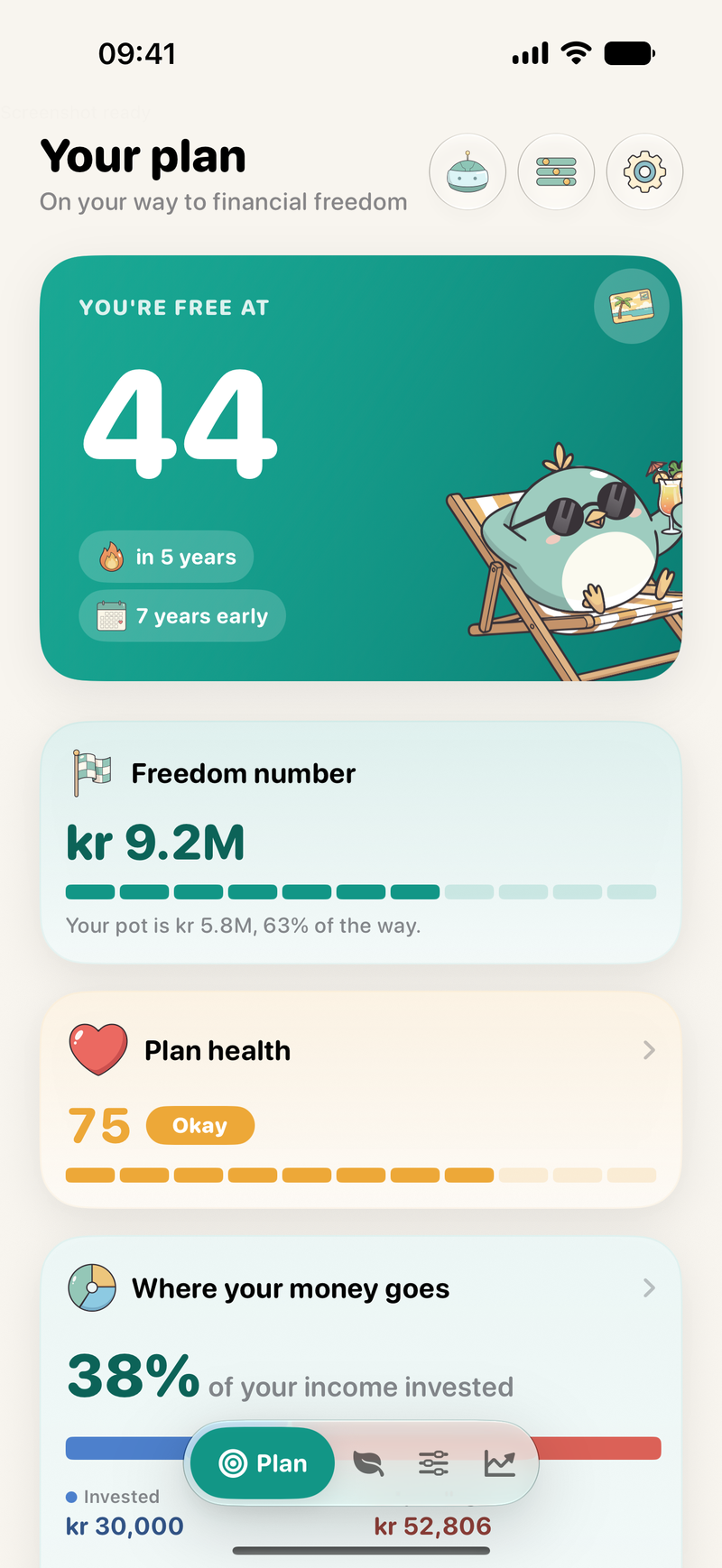
Runway gives you the one freedom number, and can model the Coast and Barista variants from your own figures, not a generic template. It launches on the App Store on 25 August 2026, and the beta is open now.
Runway gives you the one freedom number, and can model the Coast and Barista variants from your own figures, not a generic template. Your freedom age is free, forever.
Try the beta on TestFlight Download free on the App StoreFrequently asked
What are the main types of FIRE?
The main types are Regular FIRE, Lean FIRE, Fat FIRE, Coast FIRE, and Barista FIRE. Regular FIRE means saving enough to stop work fully, around 25 times your yearly spending. Lean FIRE aims at a smaller number on a frugal budget, Fat FIRE at a larger one with room to spare. Coast FIRE means saving enough early that compounding finishes the job while you stop adding. Barista FIRE means semi-retiring, with part-time income covering part of your spending. They are routes to the same freedom, not competing goals.
What is Lean FIRE?
Lean FIRE is financial independence on a deliberately low budget. Because you spend less, the pot you need is smaller and you reach it sooner. It suits people who genuinely prefer a simple, frugal life. The trade is less cushion, so a rise in costs or a stretch of high inflation hits harder than it would on a roomier budget.
What is Fat FIRE?
Fat FIRE is retiring with room to spare, a generous budget that leaves space for travel, a bigger home, or the occasional splurge. Because the spending is higher, the pot has to be larger, often much larger. The trade is time: a bigger target usually takes longer to reach, and tends to need a high income, a later finish, or both.
Which type of FIRE is best?
There is no single best type, only the one that fits you. It comes down to how much you want to spend, how much market risk you can stomach, and whether you actually want to stop working or just downshift. Someone happy with a simple life might choose Lean, someone who wants comfort might accept the longer road to Fat, someone who mainly wants breathing room now might pick Coast or Barista. They all lead to the same freedom.
Written by Dylan, maker of Runway
Italian, in Norway about eight years, building the cross-border FIRE planner that did not exist for someone like me. Runway runs entirely on your iPhone. It is an educational planning tool, not financial or tax advice.
Two of these get their own deep dive: how Coast FIRE works and how Barista FIRE works. And if you want the local, real-world version of the target number, I worked through the FIRE number in Norway. Whichever flavour you land on, the maths underneath is the same, only the dials move.