Barista FIRE
Barista FIRE: going part-time before the pot is full
The name comes from a simple picture. You leave the full-time job and, instead of stopping work entirely, pick up something lighter and part-time. In the American telling it is a coffee-shop job kept mostly for the health insurance, which is where the barista in the name comes from. The real idea underneath has nothing to do with coffee. You step off the full-time treadmill earlier than your number strictly allows, take on part-time income that covers a slice of your spending, and let your portfolio carry less of the load. You are semi-retired, not fully done.
What Barista FIRE means
The mechanics are simple. Part-time income bridges the gap between what you spend and what your pot has to provide, and your savings fund whatever is left. That does two things at once. First, you need a smaller pot, because the part-time income is already covering some of your spending, so your investments only have to cover the remainder. Second, the pot you do have lasts longer, because you are drawing less from it each year. It is the same portfolio, just with a lighter job to do.
The number you need
Your Barista number is the pot needed to cover the spending your part-time income does not, taken at a safe withdrawal rate. Subtract the income from your annual spending, then size the pot to the gap that is left. The arithmetic is the same as any FIRE number, only on a smaller figure, and it scales cleanly. Because it is a straight subtraction, covering more of your costs shrinks the pot in step:
| If part-time income covers... | ...the pot you still need is roughly |
|---|---|
| A quarter of your spending | 75% of a full FIRE number |
| A third of your spending | about 67% |
| Half of your spending | 50% |
The pot only has to cover the spending your part-time income does not, so covering more of your costs shrinks the number in step.
Why people choose it, and the catch
People reach for Barista FIRE for a few reasons. It buys freedom sooner, because a smaller number arrives years ahead of the full one. It keeps a foot in work, which some people want for the structure, the company, or simply the option to stay in the game. And it softens the psychological cliff of going from full-time to nothing overnight, which is a bigger jolt than most plans admit.
The catch is worth saying plainly. You are still working, so this is not full retirement, and the part-time income you are counting on can shrink, dry up, or come on worse terms than you assumed. Any benefits tied to that work can shift too. And in some countries the real reason people keep a job at all is not the wage, it is the healthcare that comes with it, which no line in a spreadsheet fully replaces.
Full-time to nothing is a cliff, and Barista FIRE turns it into a step.
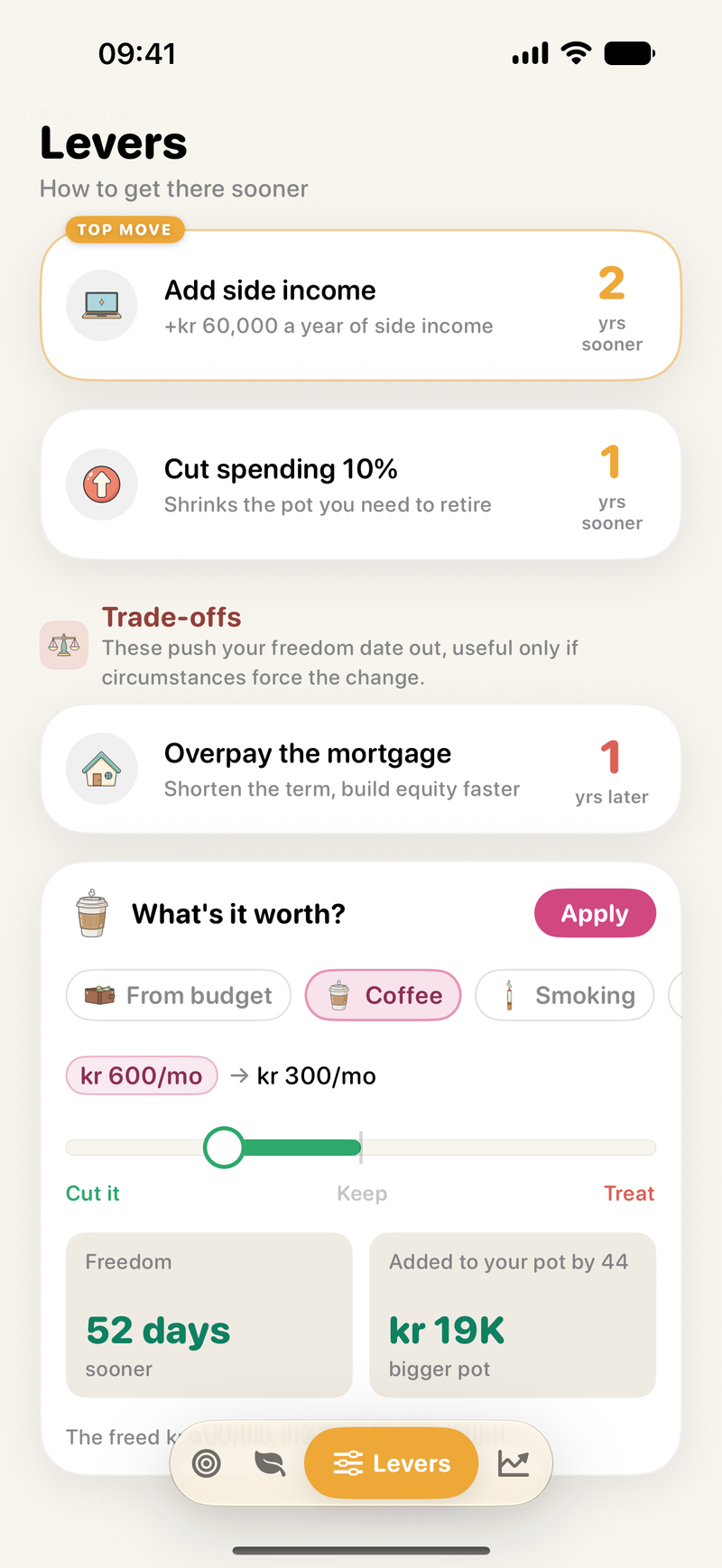

See what part-time work does to your plan
Runway has a Barista solver that models part-time income to a date and shows what it does to your plan. It launches on the App Store on 25 August 2026, and the beta is open now.
Runway has a Barista solver that models part-time income to a date and shows what it does to your plan. Your freedom age is free, forever.
Try the beta on TestFlight Download free on the App StoreFrequently asked
What is Barista FIRE?
Barista FIRE means leaving full-time work early and taking lighter, part-time income that covers part of your spending, so your portfolio only has to fund the rest. The name comes from the old idea of keeping a part-time job, and in the American version a coffee-shop one held mainly for the health insurance. You are semi-retired rather than fully done, still earning a bit, just not grinding full-time.
How much do I need for Barista FIRE?
Less than a full FIRE number. Your Barista number is the pot needed to cover your annual spending minus your part-time income, taken at a safe withdrawal rate. If part-time work covers a quarter of your spending, the pot only has to fund the other three-quarters, so it lands near 75% of a full number; cover half your spending and the pot roughly halves. The more of your costs the job covers, the smaller the pot has to be.
What is the difference between Barista FIRE and Coast FIRE?
Both step off full-time saving early, but they lean on work differently. With Barista FIRE you are drawing on your pot now and using part-time income to cover the rest of today's spending. With Coast FIRE you stop adding to the pot and let it grow on its own to your target, while a job still covers all of today's costs until then. More on the distinction in Coast FIRE.
Is Barista FIRE right for me?
It fits if you want out of the full-time grind sooner and are happy to keep some lighter work for a while, for the income, the structure, or both. It fits less well if the part-time income you are counting on is shaky, or if you are relying on a job for something money alone does not buy, like healthcare in some countries. It is a way to leave early without leaning on the pot for everything, not a way to stop working entirely.

Written by Dylan, maker of Runway
Italian, in Norway about eight years, building the cross-border FIRE planner that did not exist for someone like me. Runway runs entirely on your iPhone. It is an educational planning tool, not financial or tax advice.
Related reading: Coast FIRE, the close cousin that leans on growth instead of drawing down, and the types of FIRE for where Barista sits among the rest. This is general information to plan with, not financial advice.